Relationships were not always easy, since the archaeologists wanted to dig up the fields to expose the antiquities but the people needed to cultivate them and live from their produce. Agreements had to be made and disagreements had to be resolved.
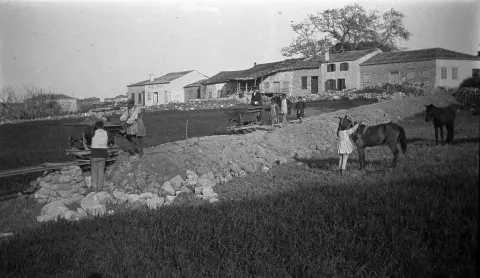
The archaeologists working with a huge workforce, up to 100 and more workmen, were moving a lot of earth using carts and donkeys in order to reveal the ancient monuments. This earth had to be dumped away from the excavations.
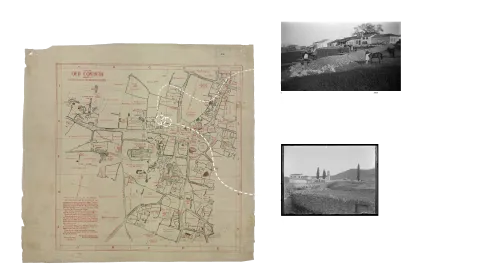
Bakoulis was a big family as is indicated on the maps of properties where the family name appears repeatedly. The field owned by the Bakoulis brothers, Serafeim, Thomas, and Ioannis, sons of Demetrios, was rented out to the archaeologists for this purpose, to dispose of the earth temporarily while the monuments were uncovered.
Correspondence between American archaeologists, Bert Hodge Hill (Director of the American School 1906-1926) and Carl W. Blegen (Secretary of the ASCSA 1913-1920), and the Bakoulis brothers describes the agreements made for the Americans to rent the field for dumping the earth, then to return it to its owners for cultivation for the remainder of the year. However, agreement on the terms and conditions of the collaboration did not come easily.
Blegen wrote, “I saw the Bakoulides today twice and had a long discussion with them. They refuse absolutely to let us cross their land except for 2 100 dr notes. 2 of them Seraphim and Thomas talked very brutally and called us liars. They assert their agreement with us was for 3 months, not for the year. The signed paper, however, which I showed them says ‘during 1914 to end of work of 1914’! They say if we attempt to run a car they will have the law on us. Finally said "the matter is finished.” We urged them to reconsider. Prospects not good.” (ASCSA Corinth Excavations Notebook 78, p. 8, October 8, 1914)
Further down, Blegen continued: “Angelis (Kosmopoulos, the foreman) says he will go ahead tomorrow in spite of Bakoulis. He has looked up law and finds it is on our side. We are required to pay damage to crop, mainly and have full rights of passage. Question of next year is different. There seems no further use in negotiating with Bakouli. It is quite impossible to deal with them. We have tried every way we could think of.” (ASCSA Corinth Excavations Notebook 78, p. 15, October 11, 1914)
The Bakoulis brothers caused problems for the archaeologists, even though they were paid a fair sum to rent out their fields for the disposal of excavation soil. Recently, Ioannis Bakoulis, one of the grandsons of the three brothers, who still lives in the village, handed over to the ASCSA a letter sent to the Bakoulis brothers by Bert Hodge Hill in 1916.
Hill stated in the letter that he had investigated in Ancient Corinth and with the Ministry of National Finance regarding the profit from the cultivation of wheat in the field as amounting to 65-75 drachmas per stremma. He thus, offered the brothers to rent their field for 75 drachmas per stremma. He concluded, “I offer this rent…because I do not want you to suffer any damage because of us.”
Excavation dump in Bakoulis Field, 1905
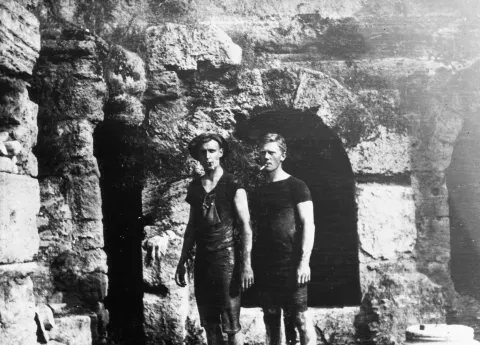
Carl W. Blegen (on the right) with Emerson Swift, both covered in mud after excavating in the tunnels of Peirene (1913-1914)
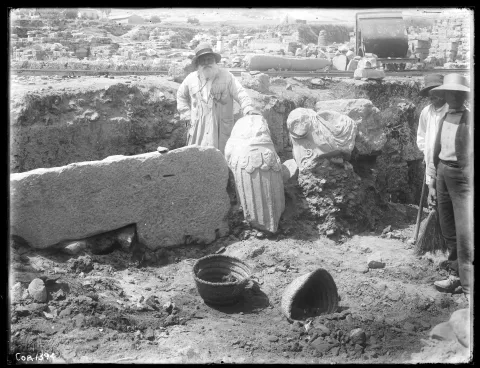
The foreman, Angelis Kosmopoulos, in the Baths of Eurykles, in 1919
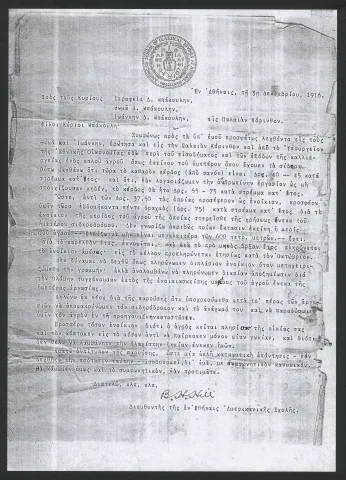
Bert Hodge Hill's letter to the Bakoulis brothers, Serafeim, Thomas, Ioannis, dated December 3, 1916
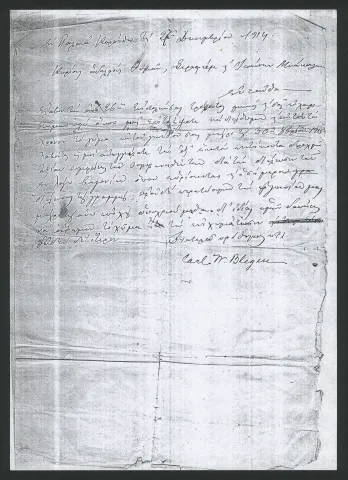
Carl W. Blegen's letter to the Bakoulis brothers, Serafeim, Thomas, Ioannis, dated December 27, 1914
Renting the Fields: The Disagreement between Hill, Blegen and the Bakoulis Brothers