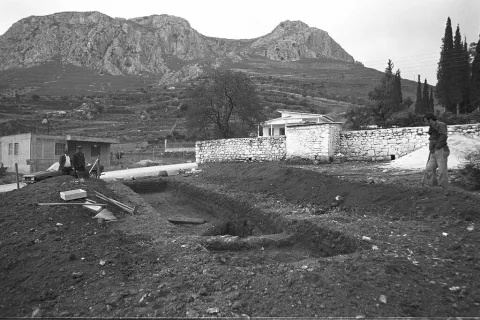
An amazing discovery was made in the area of Anaploga in 1962. During Roman times, as today, this area was the site of wealthy villas most probably because of the spectacular views it affords of the landscape.
In one of the Roman villas in the area colourful mosaics were excavated which were then transferred to the Museum by the Restoration Department of the Ministry of Culture and they are currently on display in the Roman Gallery.
From a similarly spectacular environment originates the magnificent marble head of a god/goddess that is uniquely preserving its eyes. The head is 0.54 m tall, it was presumably designed for insertion into a body of wood, part of an acrolithic statue. The top of the head was roughly finished and locks of hair just over the forehead are cut back to provide a ledge for supporting an attachment- a crown, taenia, or helmet (?). Mary C. Sturgeon concluded that it represents Athena because a helmet was most probably attached by a marble tenon. The eyeballs were separate pieces of marble, set in white plaster into hollow sockets; the pupils were of another material, and were set into the cavities in the eyeballs. The eyelashes, made of strips of bronze, were anchored in place by the eyeballs. In 2013 a similar bronze eyelash from another statue was excavated in Nezi field (cat. no. MF 2013 12). Each ear lobe was pierced for hanging earrings. Traces of gilding are preserved on the hair on the right side of the head.
Excavations of graves in the area of Anaploga in 1976
An Amazing Discovery at Anaploga: The Story of the Giambouranis-Tsimbouris-Papamichael Athena or Apollo Head