In addition to the remarkable head above, smaller artifacts have also been discovered and brought to the Corinth Museum by members of the local community. People often find antiquities while walking or working their land so they deposit the artifacts at the museum for everyone to appreciate. They know the land and its antiquities best than anybody.
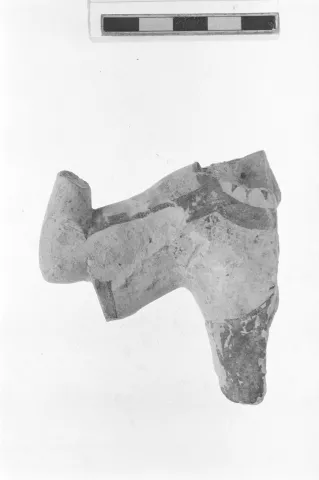
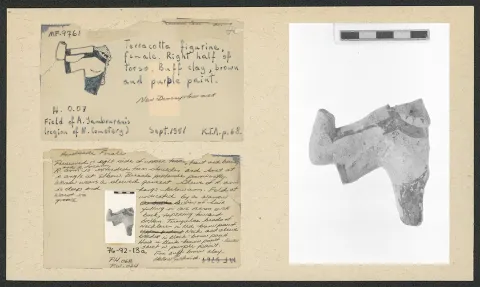
This is the story of a small terracota figurine of a running Gorgo/Medusa (cat. no. MF 9761).
We have many examples of the type in the collection in Corinth because the myth of Medusa is so central for Corinthian identity. Medusa or Gorgo was one of the three Gorgons. She had living snakes for hair and the ability to turn anyone who looked at her into stone. The Greek hero Perseus beheaded her and gave her head, which still retained its abilities, to Athena to place on her shield, thus, forming the Gorgoneion, an evil-averting weapon. From the blood of the beheaded Medusa sprung Pegasus, the flying horse, an important symbol of Corinth. Medusa appears in stone, terracotta, bronze and her powers were so entrenched in the Corinthian psyche that the symbol survives on the bezel of a Byzantine finger ring, having been Christianized with the XR symbol.
The terracota figurine of a running Gorgo/Medusa with cat. no. MF 9761 was found by A. Yambouranis in his field (region of North Cemetery) in September 1951 as is stated in the Corinth Excavations Notebook 272, p. 68. The North Cemetery is an extensive burial ground in the plain to the North of the city. Excavations by the American School brought to light 375 graves of the period 625-200BC, many of them sarcophagus burials. In recent excavations by the Greek Archaeological Service due to public works this number has been hugely augmented.
Terracotta figurine of the Gorgo/Medousa type (cat. no. MF 9761)
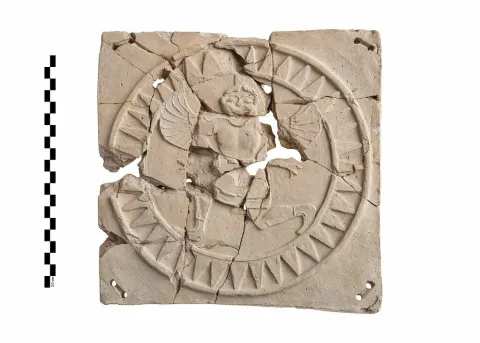
Terracotta plaque with running Gorgo/Medusa, end of 6th c. BC-beginning of 5th c. BC (cat. no. MF 1950)
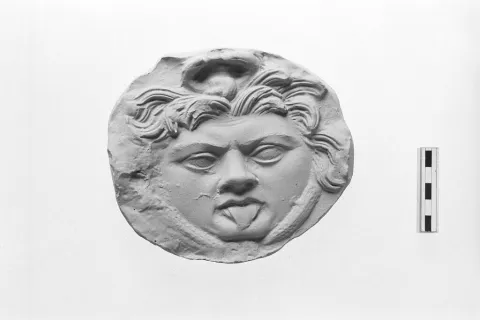
Terracotta mold with beheaded Gorgo/Medusa head, cast produced from the mold, 1st c. AD (cat. no. MF 7415)
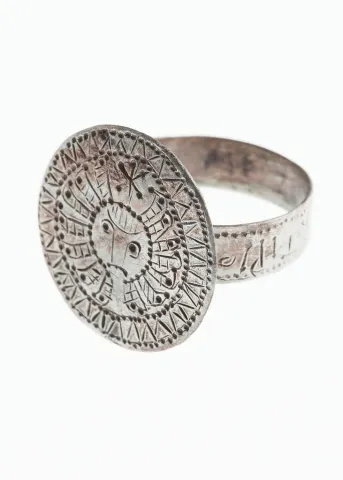
Bronze finger ring, covered in silver, with beheaded Gorgo/Medusa head on the bezel, and the inscription "protecting the womb" on the band, 10th c. AD (cat. no. MF 7677)
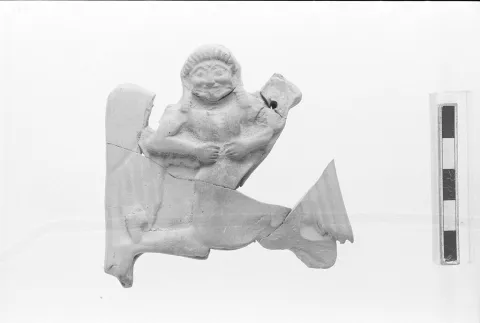
Terracotta moldmade plaque of running Gorgo/Medusa, first half 5th c. BC (cat. no. MF 9548)
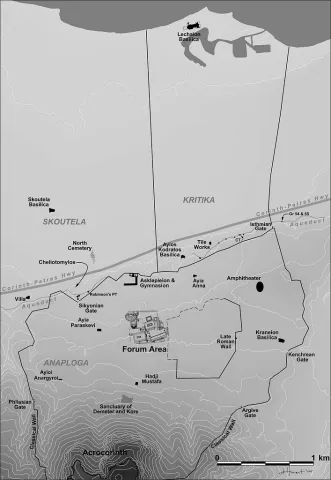
Map of Ancient Corinth with North Cemetery indicated, by J. A. Herbst
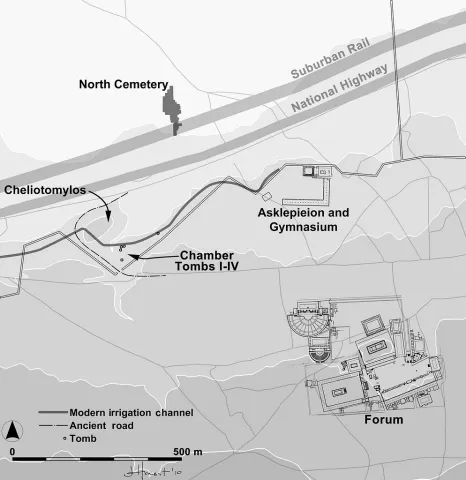
Map of Ancient Corinth with North Cemetery indicated, detail, by J. A. Herbst
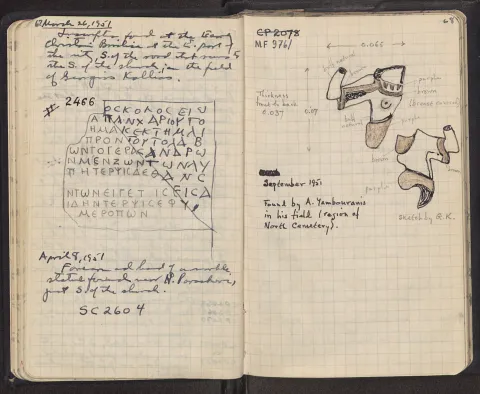
NB 272, spread 39 (pp. 67 - 68)
card
Bringing over to the Museum Surface Finds from your Fields: The Yambouranis Running Gorgo/Medousa