Living and working together, the Americans became a part of the Greek community at times of joy but also and especially in times of hardship. It was impossible to stay removed when suffering hit the village in the form of war.
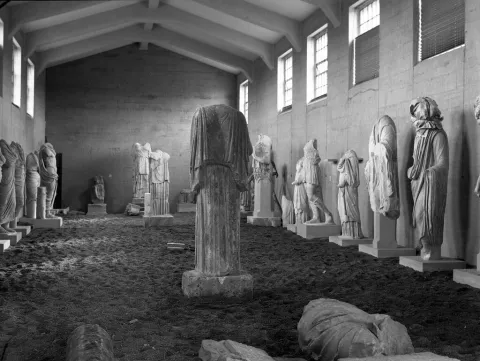
In 1941, amidst WWII, American archaeologist Bert Hodge Hill was appointed to look after the protection of the Corinth museum. Greeks and Americans worked hard to cover and protect the antiquities.
Hill did whatever was needed to protect human lives as well. After having to take refuge in an air-raid shelter on a trip to New Corinth, Hill transformed two basement rooms of Oakley House, the headquarters of ASCSA, into a shelter for the villagers of Ancient Corinth.
During the civil war, the Americans were the only ones in the village with a car. When injured fighters would come knocking late at night, requesting a ride to the hospital in New Corinth, Robert L. Scranton loaded up the School's old Chevrolet station wagon and drove them down. Word spread that the Americans had a car and were willing to help the injured parties from both sides of the conflict and the Americans drove more injured down for medical attention before the end of the war.
Oscar Broneer served as Executive Vice President of the Greek War Relief. Together with his wife, Verna, he made a memorable distribution of donated clothing in the Corinthian Agora on St. Paul’s Day in 1947, after the conclusion of the religious service that took place on the bema.
On another occasion, Broneer reports in his excavation Notebook 195, p. 61, for Thursday, February 13, 1947:
“I spent much of the day distributing clothing. In the morning, I went to Corinth where I gave two blankets each to the following young prisoners from Old Corinth:
Vasileios S. Bavellas
Christos I. Skleres
Constantinos P. Gouriotes
Georgios J. Lekkas
Demetrios A. Bouldas
A sixth prisoner, George A. Papaioannes had been taken to Nauplion for trial.
In the afternoon Pavlos and I prepared bundles mostly of women's clothing sent by Lucy Shoe-- bundles were given to all the workmen and employees of the School at Corinth: … also to the Priest who has 10 children.
- Evangelos Lekkas
- George Kachros
- Evangelos Papapsomas
- Panagiotis Nikolopoulos
- Christos Metaxas
- Spyros Kondos
- Georgios Notes
- Takis Papaioannes
- Tasos Papaioannes
- Georgios Marines
- Vasileios Metaxas
- Pavlos Daphnes
- Evgenia Armenakou
- Marigo Psomas
- Despoina Trachadakes”
Lucy Shoe Meritt served as the ASCSA Editor of Publications from 1950-1972 and worked for the Red Cross to provide aid to Greece amidst the civil war. She sent Broneer clothing to disperse to the families of the workmen and employees of the ASCSA at Corinth.
Verna Broneer, wife of Oscar Broneer, was the librarian of the School from 1930-1940, and she spent a great deal of time at Corinth, keeping records and inventorying the collection. Upon her death, the village of Ancient Corinth repaid her care and concern for them in kind. Lucy Shoe Meritt writes:
"Their spontaneous outpouring of affection and respect at her funeral on January 30, 1948 was one of the most telling of the occasions of close rapport between the School and the village which the School treasures. The village bore all the expense of the funeral including the cost of the plot in the local cemetery; old excavation workmen carried the body from Oakley House to the church where the secretary of the village and representatives of other local groups spoke eulogies and offered wreaths after the local priest had read the service. Then the whole village population, nearly a thousand people, followed the procession through the village down to the cemetery.” (“A History of the ASCSA 1939-1980" Lucy Shoe Meritt)
Corinth Museum during WW II
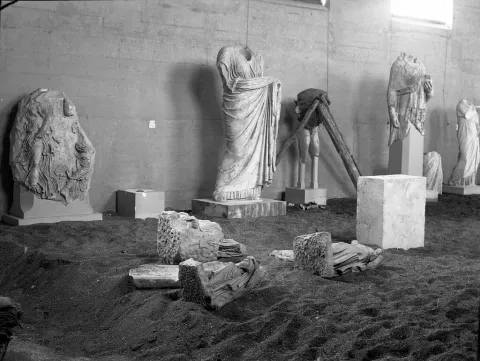
Corinth Museum during WW II
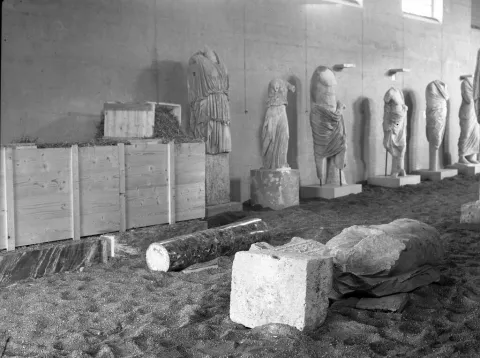
Corinth Museum during WW II
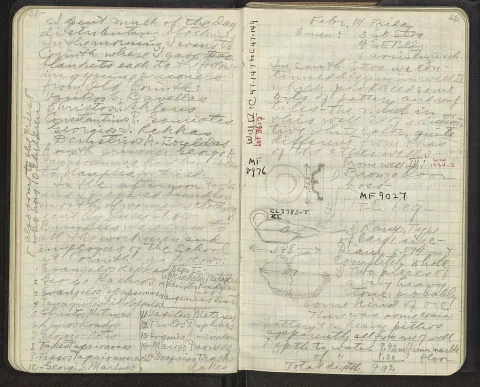
Oscar Broneer describes helping families during the civil war in 1947, Notebook 195, p. 61.
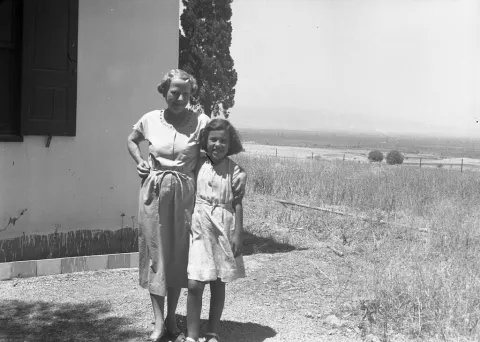
Verna Broneer with a friend in front of Oakley House
Corinth in Conflict: Families in the War