Community at Times of Joy

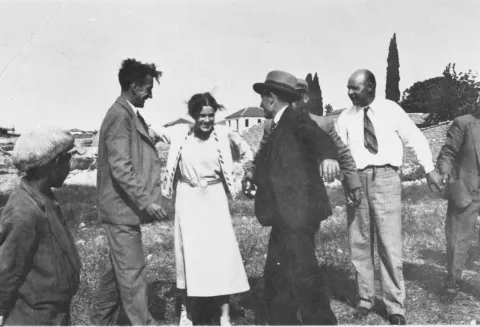
Fortunately, community is something Greeks and Americans have also shared in moments of joy. In times of celebration, we dance together as in this Easter photograph where we see R. Stillwell, A. Stillwell, D.S. Bakoulis, P. Dolias, O. Broneer, and E. Lekkas joining hands in a kalamatiano.  

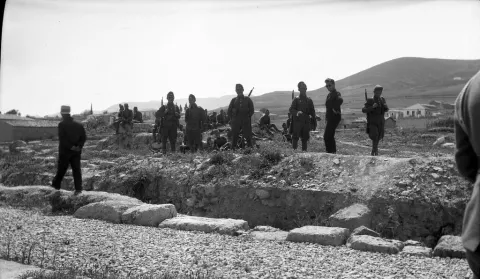
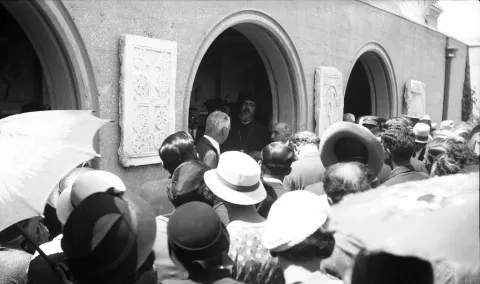
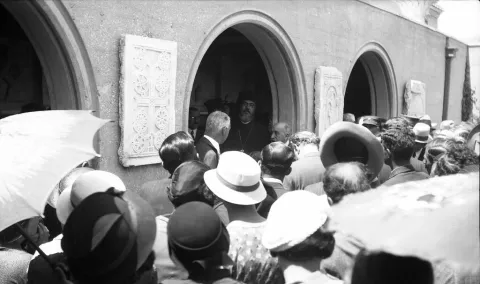
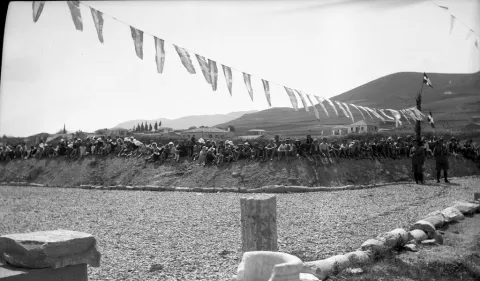
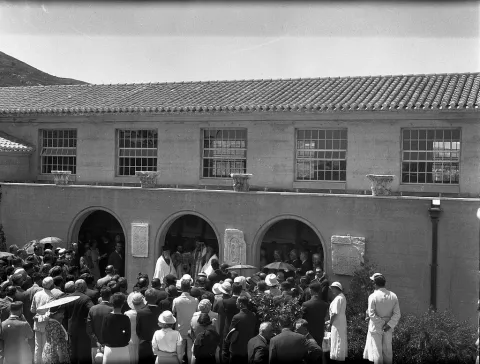
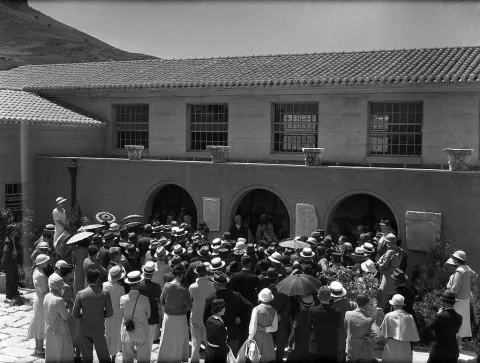
The occasion of the dedication of the Corinth Museum on 29 April 1934 was shared by the whole community. The Greek Prime Minister Panagis Tsaldaris received the building from W. Rodman Peabody, Chairman of the Trustees of the ASCSA
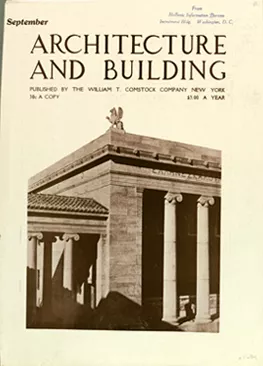
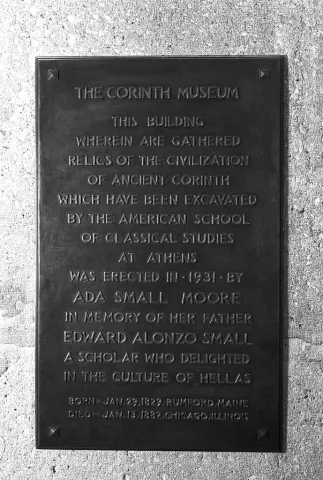
The ASCSA built the museum in 1931-2 with an addition in 1950 to house the finds of the excavations. The museum's designs were made by architect W. Stuart Thompson, whose New York office was used by Frank Lloyd Wright. The building combines the principles of modernism with historicism in architecture. The inner atrium with its arched openings evokes memories of Byzantine monasteries. The architect's goal was to create a building commensurate with the objects that were to be housed in its premises. At the museum's inauguration ceremony, the then Prime Minister of Greece, Panagis Tsaldaris, accepted the donation of the building from W. Rodman Peabody, Chairman of the American School's Board of Trustees, in the presence of the donor, Ada Small Moore. Moore donated the building in memory of her father, who loved the culture of Greece, as stated in the dedicatory inscription in the museum's vestibule. For her donation, the Greek State awarded Moore the Golden Cross of the Order of the Saviour and declared her an honorary citizen of the Municipality of Corinth. The ceremony of the dedication was attended by many people, archaeologists and locals alike. This museum, which has been in operation for over 91 years, continues to serve the needs of the broader archaeological landscape that is today Ancient Corinth. The need for a new Museum is severely felt by all of us working and living in Ancient Corinth as well as by the over 200,000 tourists who visit the site every year.

On
Υπότιτλος Εικόνας

Dedication of Museum, 29 April 1934: Prime Minister Panagis Tsaldaris received the building from W. Rodman Peabody, Chairman of the Trustees of the ASCSA

Εικόνες
Εικόνα
Εικόνα
9951_sh
Τίτλος Εικόνας

R. Stillwell, A. Stillwell, D.S. Bakoulis, P. Dolias, O. Broneer, E. Lekkas
Εικόνα
Εικόνα
w 9934 Dedication of Museum
Τίτλος Εικόνας

Dedication of Museum, 29 April 1934: Children and policemen are attending in the embankment
Εικόνα
Εικόνα
Corinth Museum dedicatory plaque
Τίτλος Εικόνας

Corinth Museum dedicatory plaque

Εικόνα
Εικόνα
Dedication of Museum, 29 April 1934: Soldiers
Τίτλος Εικόνας

Dedication of Museum, 29 April 1934: Soldiers

Εικόνα
Εικόνα
Dedication of Museum, 29 April 1934: Priests' eulogy
Τίτλος Εικόνας

Dedication of Museum, 29 April 1934: Priests' eulogy

Εικόνα
Εικόνα
Dedication of Museum, 29 April 1934: Ada Small Moore
Τίτλος Εικόνας

Dedication of Museum, 29 April 1934: Ada Small Moore

Τίτλος περιεχομένου

Community at Times of Joy
Main Media
Εικόνα
test

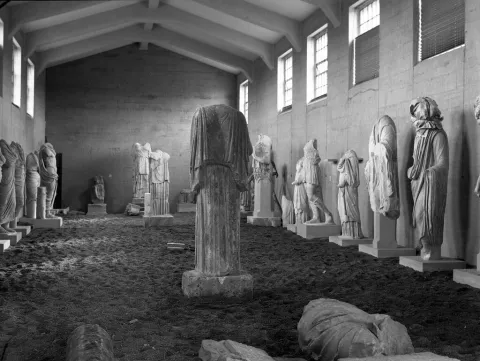
Corinth Museum during WW II

Fortunately, community is something Greeks and Americans have also shared in moments of joy. In times of celebration, we dance together as in this Easter photograph where we see R. Stillwell, A. Stillwell, D.S. Bakoulis, P. Dolias, O. Broneer, and E. Lekkas joining hands in a kalamatiano.  

The occasion of the dedication of the Corinth Museum on 29 April 1934 was shared by the whole community. The Greek Prime Minister Panagis Tsaldaris received the building from W. Rodman Peabody, Chairman of the Trustees of the ASCSA

The ASCSA built the museum in 1931-2 with an addition in 1950 to house the finds of the excavations. The museum's designs were made by architect W. Stuart Thompson, whose New York office was used by Frank Lloyd Wright. The building combines the principles of modernism with historicism in architecture. The inner atrium with its arched openings evokes memories of Byzantine monasteries. The architect's goal was to create a building commensurate with the objects that were to be housed in its premises. At the museum's inauguration ceremony, the then Prime Minister of Greece, Panagis Tsaldaris, accepted the donation of the building from W. Rodman Peabody, Chairman of the American School's Board of Trustees, in the presence of the donor, Ada Small Moore. Moore donated the building in memory of her father, who loved the culture of Greece, as stated in the dedicatory inscription in the museum's vestibule. For her donation, the Greek State awarded Moore the Golden Cross of the Order of the Saviour and declared her an honorary citizen of the Municipality of Corinth. The ceremony of the dedication was attended by many people, archaeologists and locals alike. This museum, which has been in operation for over 91 years, continues to serve the needs of the broader archaeological landscape that is today Ancient Corinth. The need for a new Museum is severely felt by all of us working and living in Ancient Corinth as well as by the over 200,000 tourists who visit the site every year.

On
Υπότιτλος Εικόνας

Dedication of Museum, 29 April 1934: Prime Minister Panagis Tsaldaris received the building from W. Rodman Peabody, Chairman of the Trustees of the ASCSA

Εικόνες
Εικόνα
Εικόνα
new-1
Τίτλος Εικόνας

test

Τίτλος περιεχομένου

Corinth Museum during WW II

Main Media
Εικόνα
bw 9937 Dedication of Museum

Corinth in Conflict: Families in the War

Living and working together, the Americans became a part of the Greek community at times of joy but also and especially in times of hardship. It was impossible to stay removed when suffering hit the village in the form of war.
In 1941, amidst WWII, American archaeologist Bert Hodge Hill was appointed to look after the protection of the Corinth museum. Greeks and Americans worked hard to cover and protect the antiquities. 

Hill did whatever was needed to protect human lives as well. After having to take refuge in an air-raid shelter on a trip to New Corinth, Hill transformed two basement rooms of Oakley House, the headquarters of ASCSA, into a shelter for the villagers of Ancient Corinth. 

During the civil war, the Americans were the only ones in the village with a car. When injured fighters would come knocking late at night, requesting a ride to the hospital in New Corinth, Robert L. Scranton loaded up the School's old Chevrolet station wagon and drove them down. Word spread that the Americans had a car and were willing to help the injured parties from both sides of the conflict and the Americans drove more injured down for medical attention before the end of the war. 

Oscar Broneer served as Executive Vice President of the Greek War Relief. Together with his wife, Verna, he made a memorable distribution of donated clothing in the Corinthian Agora on St. Paul’s Day in 1947, after the conclusion of the religious service that took place on the bema.

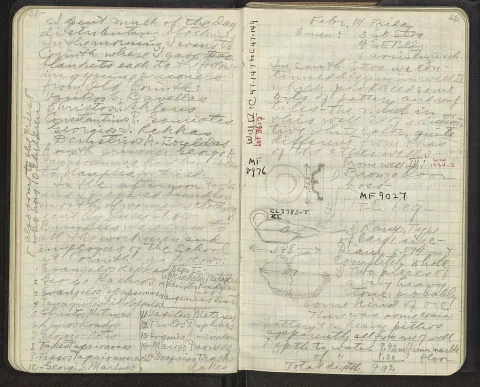
On another occasion, Broneer reports in his excavation Notebook 195, p. 61, for Thursday, February 13, 1947: 


“I spent much of the day distributing clothing.  In the morning, I went to Corinth where I gave two blankets each to the following young prisoners from Old Corinth:

Vasileios S. Bavellas 

Christos I. Skleres

Constantinos P. Gouriotes
Georgios J. Lekkas
Demetrios A. Bouldas
A sixth prisoner, George A. Papaioannes had been taken to Nauplion for trial.

In the afternoon Pavlos and I prepared bundles mostly of women's clothing sent by Lucy Shoe-- bundles were given to all the workmen and employees of the School at Corinth: … also to the Priest who has 10 children.


  • Evangelos Lekkas
  • George Kachros
  • Evangelos Papapsomas
  • Panagiotis Nikolopoulos
  • Christos Metaxas
  • Spyros Kondos
  • Georgios Notes
  • Takis Papaioannes
  • Tasos Papaioannes
  • Georgios Marines
  • Vasileios Metaxas
  • Pavlos Daphnes
  • Evgenia Armenakou
  • Marigo Psomas
  • Despoina Trachadakes”

Lucy Shoe Meritt served as the ASCSA Editor of Publications from 1950-1972 and worked for the Red Cross to provide aid to Greece amidst the civil war. She sent Broneer clothing to disperse to the families of the workmen and employees of the ASCSA at Corinth. 

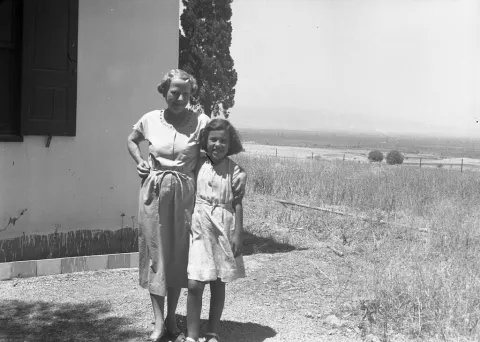
Verna Broneer, wife of Oscar Broneer, was the librarian of the School from 1930-1940, and she spent a great deal of time at Corinth, keeping records and inventorying the collection.  Upon her death, the village of Ancient Corinth repaid her care and concern for them in kind. Lucy Shoe Meritt writes: 


"Their spontaneous outpouring of affection and respect at her funeral on January 30, 1948 was one of the most telling of the occasions of close rapport between the School and the village which the School treasures. The village bore all the expense of the funeral including the cost of the plot in the local cemetery; old excavation workmen carried the body from Oakley House to the church where the secretary of the village and representatives of other local groups spoke eulogies and offered wreaths after the local priest had read the service. Then the whole village population, nearly a thousand people, followed the procession through the village down to the cemetery.” (“A History of the ASCSA 1939-1980" Lucy Shoe Meritt) 


On
Υπότιτλος Εικόνας

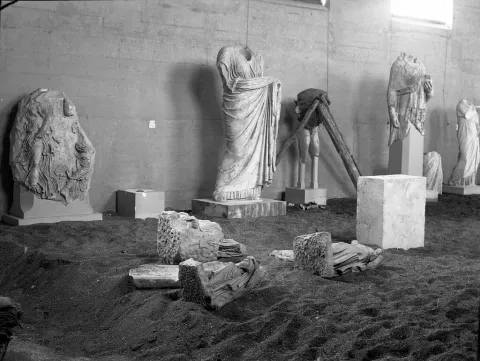
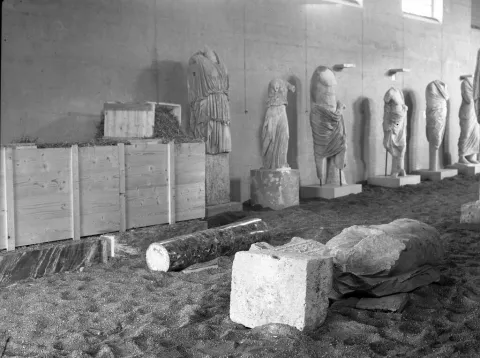
Corinth Museum during WW II

Εικόνες
Εικόνα
Εικόνα
bw 6050 New Museum - wartime condition
Τίτλος Εικόνας

Corinth Museum during WW II

Εικόνα
Εικόνα
bw 6051 New Museum - wartime condition
Τίτλος Εικόνας

Corinth Museum during WW II

Εικόνα
Εικόνα
0
Τίτλος Εικόνας

Oscar Broneer describes helping families during the civil war in 1947, Notebook 195, p. 61.  

Εικόνα
Εικόνα
bw 9925
Τίτλος Εικόνας

Verna Broneer with a friend in front of Oakley House

Τίτλος περιεχομένου

Corinth in Conflict: Families in the War

Main Media
Εικόνα
 bw 6049 New Museum - wartime condition.jpg

Tseliolophos

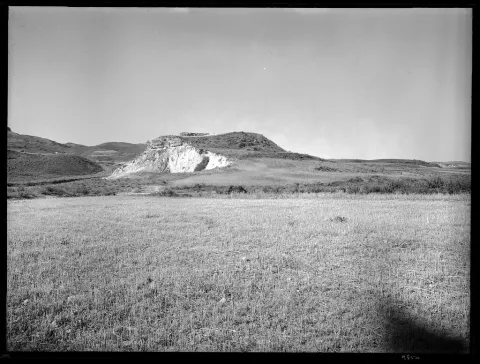
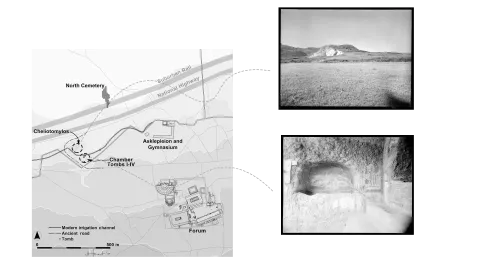
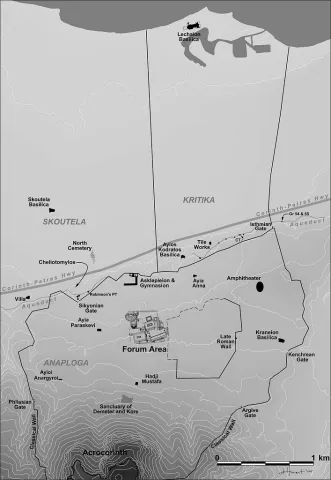
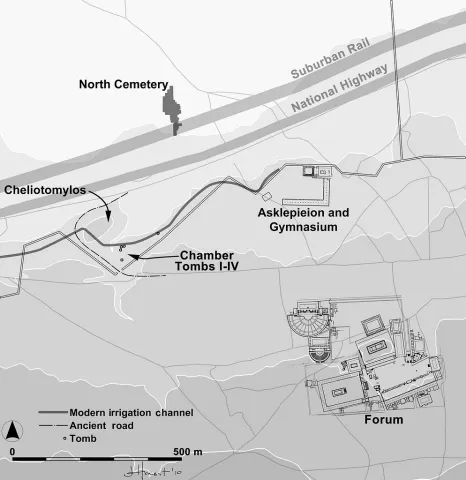
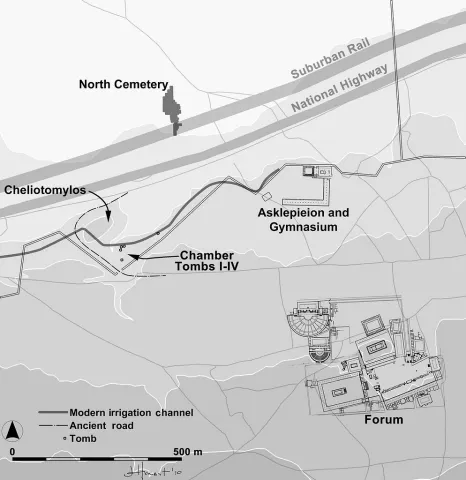
North-west of the Roman forum two hills are located overlooking the plain to the North. Cheliotomylos was the hill where the family of Cheliotis had a mill. Tseliolophos was the hill to the east of Cheliotomylos and separated from it by a ravine. The Tselios family owned property there.  Archaeologists refer to these hills as Cheliotomylos and Tseliolophos. During the early 1930s 117 Geometric to Roman graves and several chamber tombs were found at Cheliotomylos. The most striking find was a well that contained a great mass of Early Helladic pottery of the 3 rd millennium BC and 17 human skeletons.

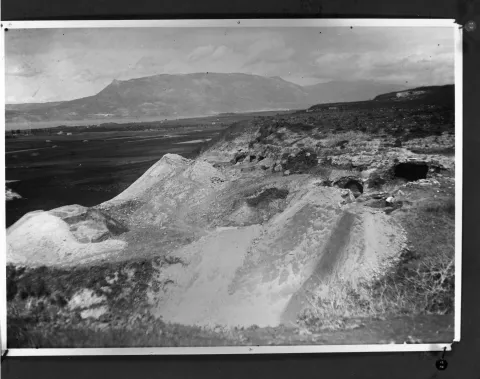
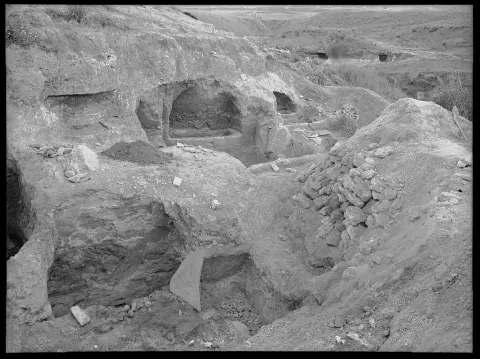
Excavations at Tseliolophos under the direction of T. Leslie Shear Sr., but conducted by his wife, Josephine Platner, during 1931 revealed that the area concealed a small Roman cemetery of 4 chamber tombs.

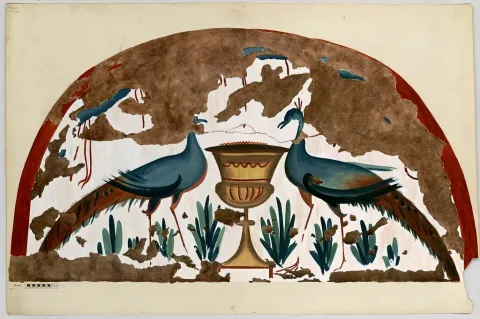
Among the graves the most spectacular was Chamber Tomb II or the Shear Painted Tomb, as it is now known. The tomb dates to the early 2nd c. AD and belonged to a wealthy Corinthian family. It was a substantial edifice with an imposing entrance and an elaborately decorated interior. Shear commented, “A tomb of this magnificence must have been constructed for a man of wealth and distinction, and the presence of military guards at each side of the grave implies some official association.” For Mary Walbank, the armed guards are rather mythological figures, the Dioskouroi, as savior gods and as a sign that the dead too may achieve immortality. The tomb was reused in the 5 th -6 th c. AD 

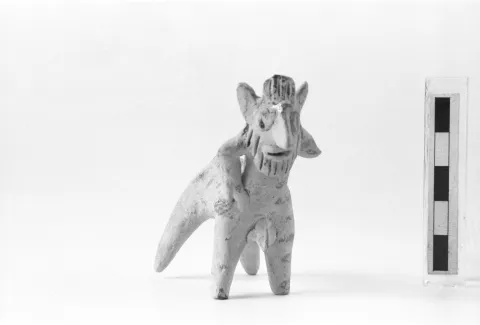
From the excavations within the tomb and in the area around numerous finds came to light. A complete Geometric painted terracotta figurine of a centaur was found in fill lower down the slope to the NW of the tombs. 

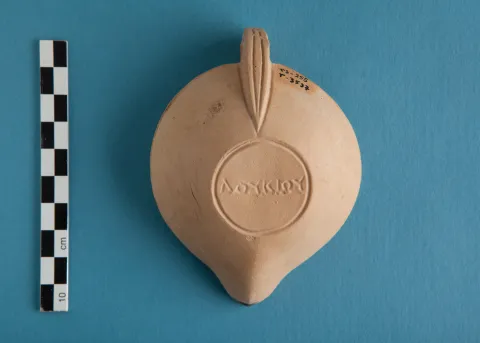
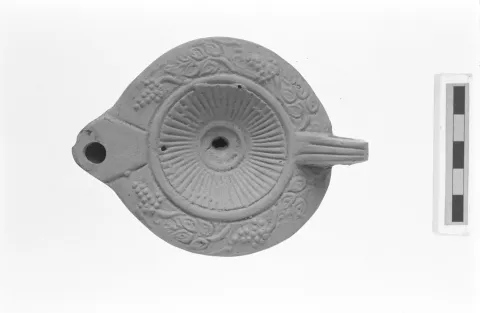
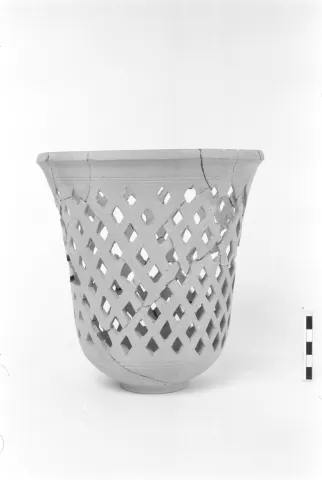
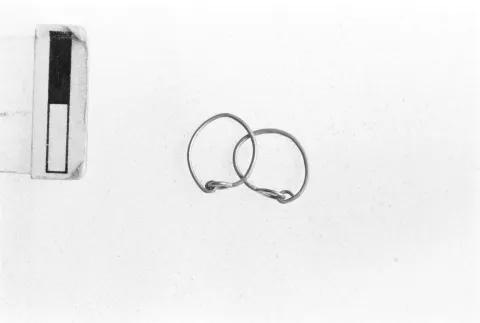
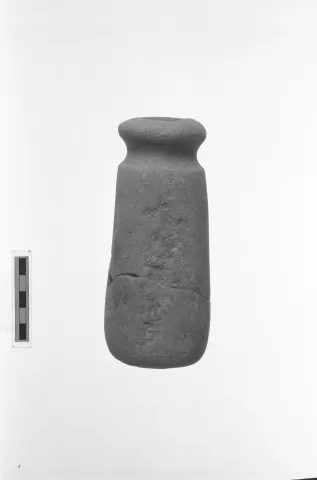
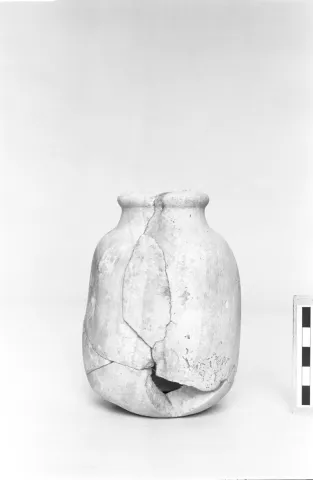
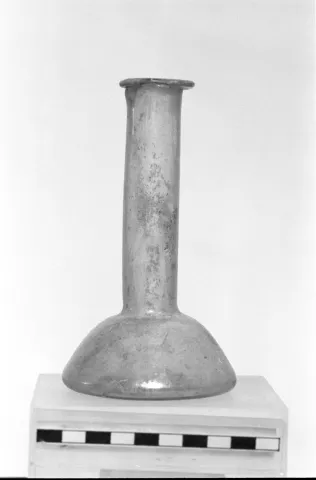
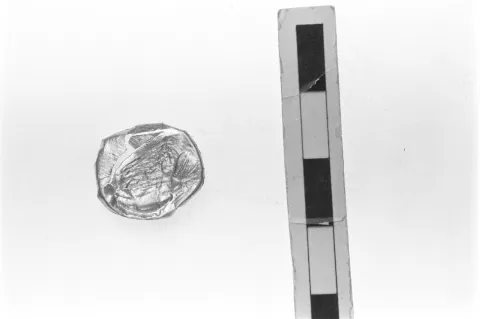
Grave goods from within the tomb include terracotta lamps, pottery, glass vessels, alabastra for expensive perfumed oils, gold foil coins for the Charon, and jewellery.

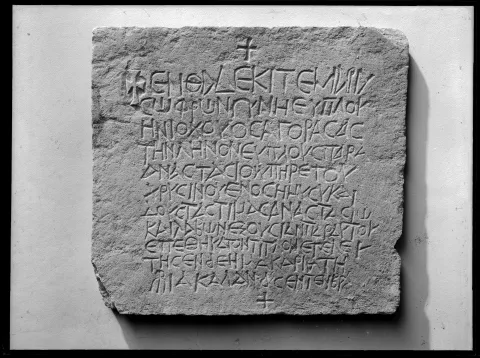
From Chamber Tomb IV, in the neighbourhood of the Shear Painted Tomb, comes an inscription, which was cemented in the entrance. It is dated in the first half of the 6th c. AD and it records the purchase of a grave by Euplous, the charioteer, for his wife, Maria. The inscription records that Euplous paid one and a half gold pieces, which was the going rate for a grave in a desirable location. The purchase was negotiated with Anastasios, a minor ecclesiastical official.


On
Υπότιτλος Εικόνας

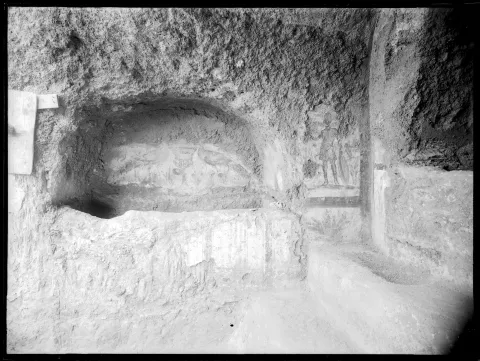
Interior of Shear Painted Tomb decoration, wall-painting of peacocks, symbols of immortality, by Mary Wyckof

Εικόνες
Εικόνα
Εικόνα
bw 9512 View of Cheliotomylos
Τίτλος Εικόνας

View from North of Cheliotomylos on the right and Tseliolophos on the left

Εικόνα
Εικόνα
2001_sh_006_049
Τίτλος Εικόνας

Tseliolophos: view of graves during excavations from SW, Geraneia in the distance, 1931

Εικόνα
Εικόνα
Tseliolophos: view of graves during excavations from N, tombs I and II, 1931
Τίτλος Εικόνας

Tseliolophos: view of graves during excavations from N, tombs I and II, 1931

Εικόνα
Εικόνα
0555_s028
Τίτλος Εικόνας

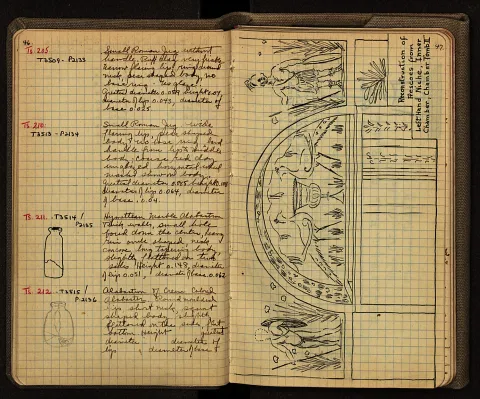
Corinth Notebook 555, pp. 46-47, list of excavation finds and drawing of decoration of interior of tomb with peacocks and Dioskouroi, by Josephine Platner Shear

Εικόνα
Εικόνα
9097_gp@0.5x.
Τίτλος Εικόνας

Interior of Shear Painted Tomb decoration

Εικόνα
Εικόνα
Corinth Drawing 222 017 area plan
Τίτλος Εικόνας

Map of Ancient Corinth with Cheliotomylos indicated. Tseliolophos is the hill where chamber tombs I-IV are located. By J. A. Herbst

Εικόνα
Εικόνα
Handmade figurine of a centaur (cat. no. T 3522)
Τίτλος Εικόνας

Handmade figurine of a centaur (cat. no. T 3522) 

Εικόνα
Εικόνα
2013_0311.
Τίτλος Εικόνας

Type XXVII lamp with the signature of the lamp maker Loukios, 3rd c. AD, bottom of lamp (cat. no. T 3537)

Εικόνα
Εικόνα
1999_st_003_027
Τίτλος Εικόνας

Type XXVII lamp with the signature of the lamp maker Loukios, 3rd c. AD, top of lamp (cat. no. T 3537)

Εικόνα
Εικόνα
1990_st_032_022
Τίτλος Εικόνας

Lattice-work clay kalathos, 2nd or 3rd c. AD (cat. no. T 3343)

Εικόνα
Εικόνα
1984_st_004_021A
Τίτλος Εικόνας

Gold earrings of the 1st-3rd c. AD (cat. no. T 3518)

Εικόνα
Εικόνα
2006_st_028_028
Τίτλος Εικόνας

Marble alabastron for perfumed oils of uncertain date (cat. no. T 3514)

Εικόνα
Εικόνα
1999_st_007_026
Τίτλος Εικόνας

Alabaster alabastron for perfumed oils of uncertain date  (cat. no. T 3515)

Εικόνα
Εικόνα
2001_st_004_016
Τίτλος Εικόνας

Conical unguentarium or glass bottle for oil for preparing the corpse (cat. no. T 3347)

Εικόνα
Εικόνα
1999_st_020_012
Τίτλος Εικόνας

Gold danake or Charon's fee, gold foil impression with Sikyonian dove (cat. no. T 3332)

Εικόνα
Εικόνα
9100_gp
Τίτλος Εικόνας

Grave inscription for Maria, wife of Euplous, the charioteer (cat. no.  I 2301 )

Τίτλος περιεχομένου

Tseliolophos

Main Media
Εικόνα
Interior of Shear Painted Tomb decoration, wall-painting of peacocks, symbols of immortality, by Mary Wyckof
Αρχική φωτογραφία
Εικόνα
tselios

Bringing over to the Museum Surface Finds from your Fields: The Yambouranis Running Gorgo/Medousa


In addition to the remarkable head above, smaller artifacts have also been discovered and brought to the Corinth Museum by members of the local community. People often find antiquities while walking or working their land so they deposit the artifacts at the museum for everyone to appreciate. They know the land and its antiquities best than anybody.

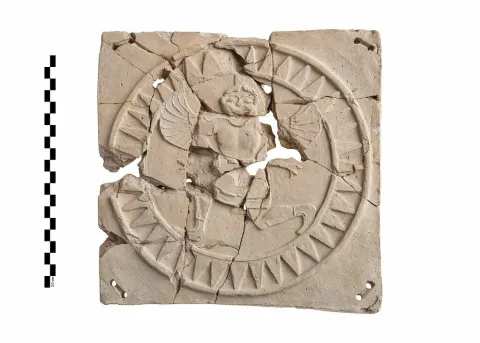
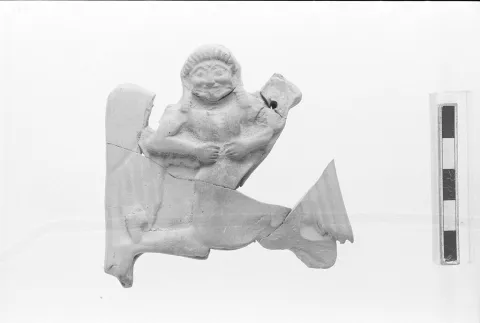
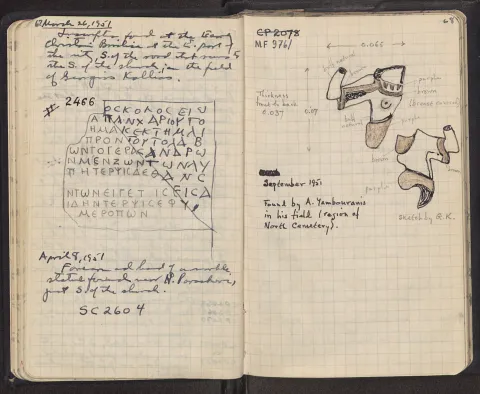
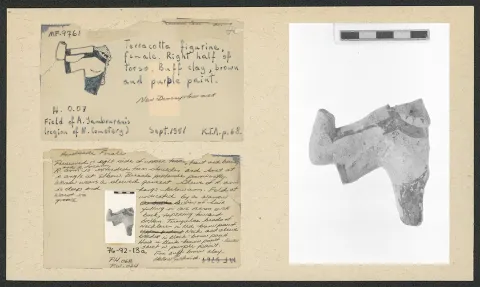
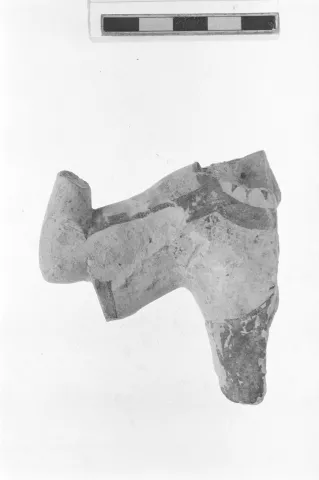
This is the story of a small terracota figurine of a running Gorgo/Medusa (cat. no. MF 9761). 

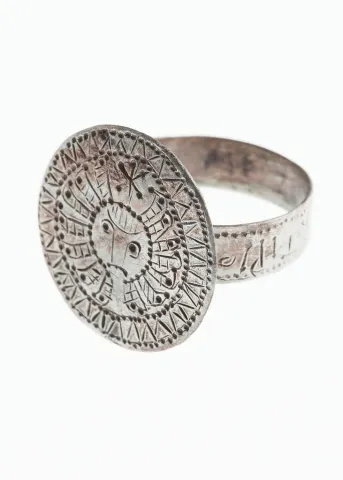
We have many examples of the type in the collection in Corinth because the myth of Medusa is so central for Corinthian identity. Medusa or Gorgo was one of the three Gorgons. She had living snakes for hair and the ability to turn anyone who looked at her into stone. The Greek hero Perseus beheaded her and gave her head, which still retained its abilities, to Athena to place on her shield, thus, forming the Gorgoneion, an evil-averting weapon. From the blood of the beheaded Medusa sprung Pegasus, the flying horse, an important symbol of Corinth. Medusa appears in stone, terracotta, bronze and her powers were so entrenched in the Corinthian psyche that the symbol survives on the bezel of a Byzantine finger ring, having been Christianized with the XR symbol.

The terracota figurine of a running Gorgo/Medusa with cat. no. MF 9761 was found by A. Yambouranis in his field (region of North Cemetery) in September 1951 as is stated in the Corinth Excavations Notebook 272, p. 68. The North Cemetery is an extensive burial ground in the plain to the North of the city. Excavations by the American School brought to light 375 graves of the period 625-200BC, many of them sarcophagus burials. In recent excavations by the Greek Archaeological Service due to public works this number has been hugely augmented.


On
Υπότιτλος Εικόνας

Terracotta figurine of the Gorgo/Medousa type (cat. no. MF 9761)

Εικόνες
Εικόνα
Εικόνα
Terracotta plaque with running Gorgo/Medusa, end of 6th c. BC-beginning of 5th c. BC (cat. no. MF 1950)
Τίτλος Εικόνας

Terracotta plaque with running Gorgo/Medusa, end of 6th c. BC-beginning of 5th c. BC (cat. no. MF 1950)

Εικόνα
Εικόνα
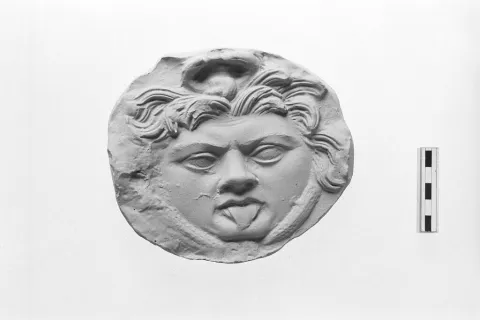
Terracotta mold with beheaded Gorgo/Medusa head, cast produced from the mold, 1st c. AD (cat. no. MF 7415)
Τίτλος Εικόνας

Terracotta mold with beheaded Gorgo/Medusa head, cast produced from the mold, 1st c. AD (cat. no. MF 7415)

Εικόνα
Εικόνα
Bronze finger ring, covered in silver, with beheaded Gorgo/Medusa head on the bezel, and the inscription "protecting the womb" on the band, 10th c. AD (cat. no. MF 7677)
Τίτλος Εικόνας

Bronze finger ring, covered in silver, with beheaded Gorgo/Medusa head on the bezel, and the inscription "protecting the womb" on the band, 10th c. AD (cat. no. MF 7677)

Εικόνα
Εικόνα
Terracotta moldmade plaque of running Gorgo/Medusa, first half 5th c. BC (cat. no. MF 9548)
Τίτλος Εικόνας

Terracotta moldmade plaque of running Gorgo/Medusa, first half 5th c. BC (cat. no. MF 9548)

Εικόνα
Εικόνα
Map of Ancient Corinth with North Cemetery indicated, by J. A. Herbst
Τίτλος Εικόνας

Map of Ancient Corinth with North Cemetery indicated, by J. A. Herbst

Εικόνα
Εικόνα
Map of Ancient Corinth with North Cemetery indicated, detail, by J. A. Herbst
Τίτλος Εικόνας

Map of Ancient Corinth with North Cemetery indicated, detail, by J. A. Herbst

Εικόνα
Εικόνα
NB 272, spread 39 (pp. 67 - 68)
Τίτλος Εικόνας

NB 272, spread 39 (pp. 67 - 68)

Εικόνα
Εικόνα
card
Τίτλος Εικόνας

card

Τίτλος περιεχομένου

Bringing over to the Museum Surface Finds from your Fields: The Yambouranis Running Gorgo/Medousa

Main Media
Εικόνα
1976_st_092_013A

An Amazing Discovery at Anaploga 2

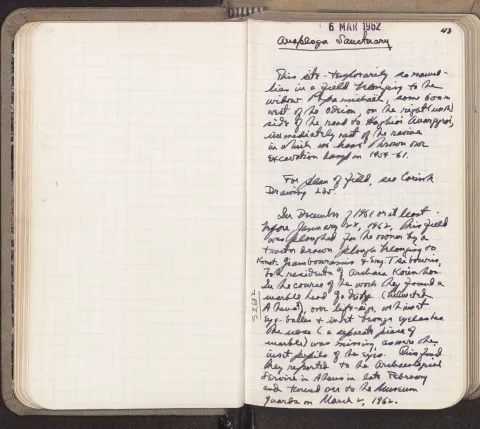
The story of the head’s discovery is related by Henry S. Robinson in Corinth excavation notebook 239.

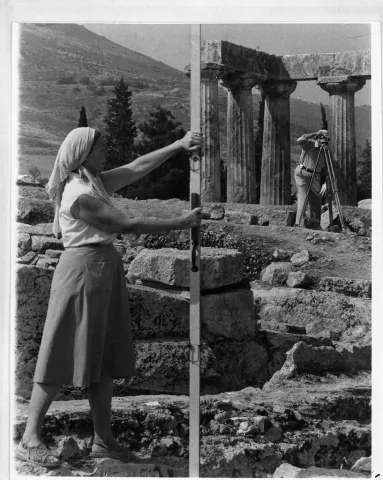
Henry S. Robinson was both director of the ASCSA from 1959-1969 and director of Corinth Excavations from 1959-1965. While excavations were conducted continuously from 1896, there were times due to historical events in Greece that excavations were interrupted. After such an interruption, Robinson resumed annual excavations at Ancient Corinth in 1959 and excavations have been happening continuously ever since. Robinson decided that holding both a directorship of ASCSA and Corinth was an immense task and, thus, he appointed C. K. Williams II as the first independent director of the Corinth Excavations. Williams retired from the position in 1997.

Robinson reports on the location of the find of the head as follows:


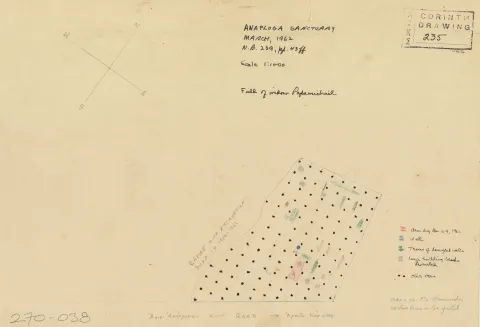
“This site lies in a field belonging to the widow of Papamichael, some 600m west of the Odeion, on the right (north) side of the road to Haghioi Anargyroi, immediately east of the ravine in which we have thrown our excavation dump in 1959-1961.”


And the story, as it unfolds in Robinson’s excavation notebook, is as follows:


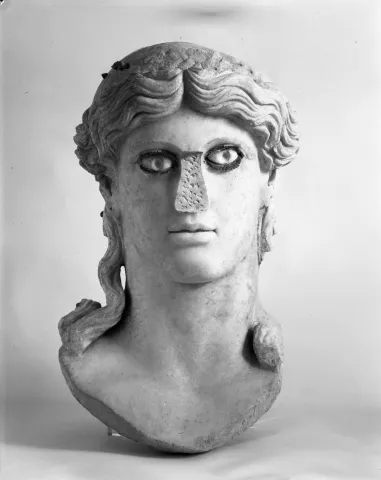
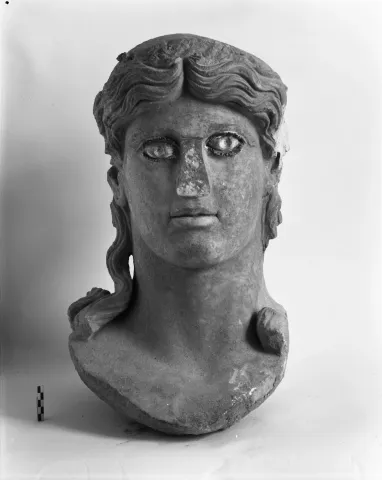
“In December of 1961 or at least before January 1962, the field was ploughed for the owner by a tractor drawn plough belonging to Konst. Giambouranis and Evag. Tsibouris, both residents of Archaia Korinthos. In the course of the work they found a marble head of a deity, over life-size, with inset eyeballs and inset bronze eyelashes. The nose was missing, as were the inset pupils of the eyes. This find they reported to the Archaeological Service in Athens in late February and turned over to the Corinth Museum guards on March 2, 1962.

Mr. Verdelis, the Ephor, requested us to dig briefly in the area where the head was found in an attempt to recover the nose and pupils. With four workmen we undertook to dig in the area where Giambouranis and Tsibouris reported the discovery of the head. During the day the man who drove the Giambouranis-Tsibouris tractor on the day of the discovery of the head reported that the head was in the area just north, and at end of day practically on the line between the two areas designated we found one of the locks of hair from the right side of the neck of the head. Since the discovery of the head, the owner has planted his field with olive trees. We have agreed with the son of the widow Papamichael that after the spring excavation we will refill our trenches and replant such olives as we removed, paying him some compensation for loss of growing time of the trees. If, however, the finds are such as to warrant leaving the trenches open, we will negotiate for the purchase of the property.”


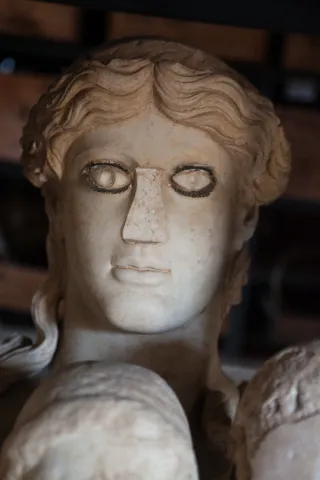
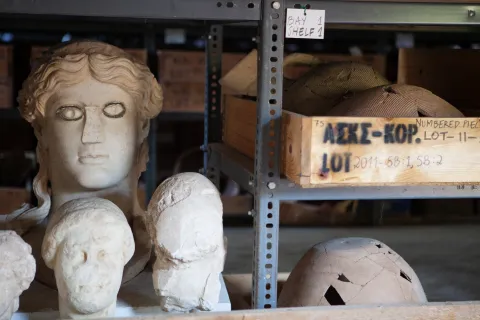
The head of Athena/Apollo is not on display in the Corinth Museum but rather is kept in storage among other spectacular marble portraits.


Off
Υπότιτλος Εικόνας

Marble head of Athena or Apollo, after cleaning (cat. no. S 2682)

Εικόνες
Εικόνα
Εικόνα
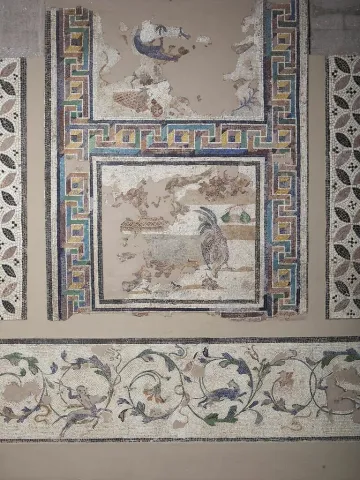
Roman mosaic from villa in Anaploga during excavation
Τίτλος Εικόνας

Roman mosaic from villa in Anaploga during excavation

Εικόνα
Εικόνα
Roman mosaic from villa in Anaploga as displayed in the Corinth Museum
Τίτλος Εικόνας

Roman mosaic from villa in Anaploga as displayed in the Corinth Museum

Εικόνα
Εικόνα
Marble head of Athena or Apollo, before cleaning (cat. no. S 2682)
Τίτλος Εικόνας

Marble head of Athena or Apollo, before cleaning (cat. no. S 2682)

Εικόνα
Εικόνα
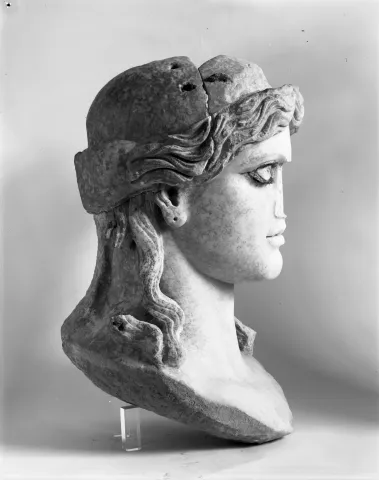
Marble head of Athena or Apollo, side view (cat. no. S 2682)
Τίτλος Εικόνας

Marble head of Athena or Apollo, side view (cat. no. S 2682)

Εικόνα
Εικόνα
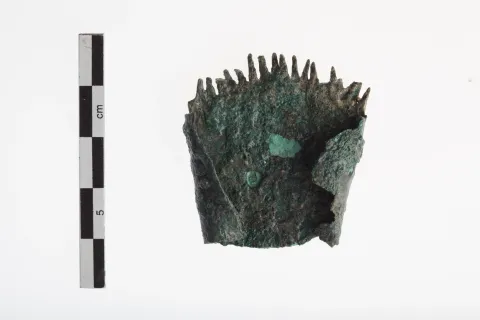
Bronze eyelash from Nezi field (cat. no. MF 2013 12)
Τίτλος Εικόνας

Bronze eyelash from Nezi field (cat. no. MF 2013 12)

Εικόνα
Εικόνα
Henry and Rebecca Robinson during the excavations on Temple Hill, 1964
Τίτλος Εικόνας

Henry and Rebecca Robinson during the excavations on Temple Hill, 1964

Εικόνα
Εικόνα
Plan showing the location where the marble head of Athena or Apollo was found
Τίτλος Εικόνας

Plan showing the location where the marble head of Athena or Apollo was found

Εικόνα
Εικόνα
Notebook page (Notebook 239, p. 43) where Henry Robinson describes the story of discovery of the Athena/Apollo marble head.
Τίτλος Εικόνας

Notebook page (Notebook 239, p. 43) where Henry Robinson describes the story of discovery of the Athena/Apollo marble head.

Εικόνα
Εικόνα
Marble head of Athena or Apollo, in storage (cat. no. S 2682)
Τίτλος Εικόνας

Marble head of Athena or Apollo, in storage (cat. no. S 2682)

Εικόνα
Εικόνα
Marble head of Athena or Apollo, in storage (cat. no. S 2682)
Τίτλος Εικόνας

Marble head of Athena or Apollo, in storage (cat. no. S 2682)

Main Media
Εικόνα
1962_sh_086_029

An Amazing Discovery at Anaploga

An amazing discovery was made in the area of Anaploga in 1962. During Roman times, as today, this area was the site of wealthy villas most probably because of the spectacular views it affords of the landscape.


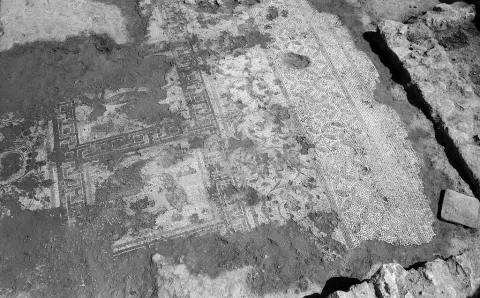
In one of the Roman villas in the area colourful mosaics were excavated which were then transferred to the Museum by the Restoration Department of the Ministry of Culture and they are currently on display in the Roman Gallery.

From a similarly spectacular environment originates the magnificent marble head of a god/goddess that is uniquely preserving its eyes. The head is 0.54 m tall, it was presumably designed for insertion into a body of wood, part of an acrolithic statue. The top of the head was roughly finished and locks of hair just over the forehead are cut back to provide a ledge for supporting an attachment- a crown, taenia, or helmet (?). Mary C. Sturgeon concluded that it represents Athena because a helmet was most probably attached by a marble tenon. The eyeballs were separate pieces of marble, set in white plaster into hollow sockets; the pupils were of another material, and were set into the cavities in the eyeballs. The eyelashes, made of strips of bronze, were anchored in place by the eyeballs. In 2013 a similar bronze eyelash from another statue was excavated in Nezi field (cat. no. MF 2013 12). Each ear lobe was pierced for hanging earrings. Traces of gilding are preserved on the hair on the right side of the head. 

On
Υπότιτλος Εικόνας

Excavations of graves in the area of Anaploga in 1976

Τίτλος περιεχομένου

An Amazing Discovery at Anaploga: The Story of the Giambouranis-Tsimbouris-Papamichael Athena or Apollo Head 

Main Media
Εικόνα
1976

Oscar Broneer Excavating in Vlachos’ Field

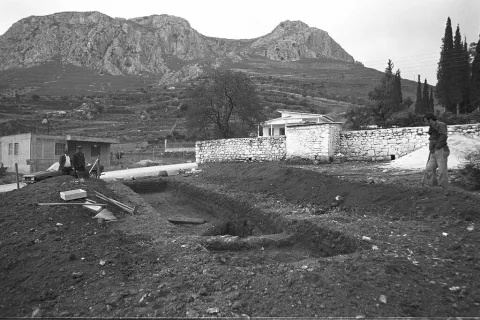
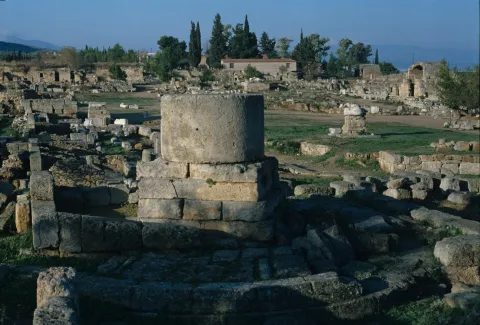
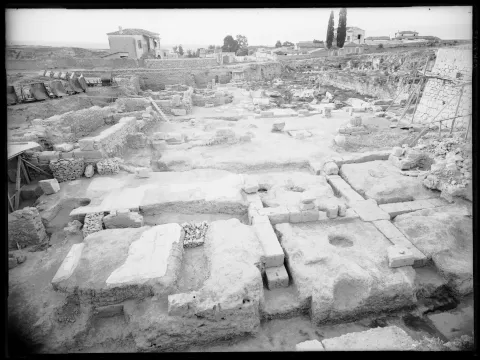
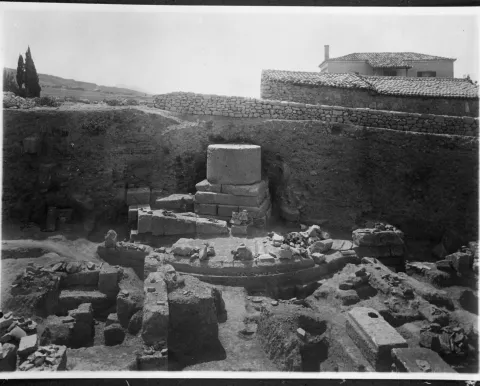
In 1933 Oscar Broneer was excavating in the Vlachos Field in the Forum. The field was bought for 20,000 (10,000 drachmas/stremma), “High price!” in ASCSA Corinth Excavations Notebook 132, p. 72, December 1, 1922. The excavators uncovered the circular base of a huge monument, the Circular Monument. Only the base is preserved, parts of the second drum were broken up and built into gate posts, so it is difficult to know what it originally supported. 


Oscar Broneer was a prominent archaeologist who served as acting director of the ASCSA from 1947-1948 and directed excavations at Isthmia from 1952-1956.  In Corinth he excavated for many decades and brought to light and published two significant monuments, the Odeion and the South Stoa. Broneer dedicated his life to the Corinthia, adopted Ancient Corinth as his home, served as the Executive Vice President of the Greek War Relief Association in New York City during WWII and was awarded the Royal Hellenic Order of the Phoenix for acts of dedication to his adopted country in 1962. He filmed the Triumph Over Time in 1947. Broneer died in 1992 and was buried in the village cemetery.  

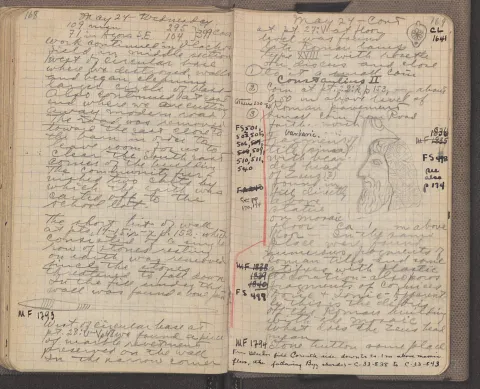
During his excavations in the Vlachos field, he wrote in ASCSA Corinth Excavations Notebook 135, pp. 168-169, May 24, 1933: 


“Wednesday May 24, 1933
109 men, 71 in Agora SE
295 and 104 cars for a total of 399 cars (of dumped earth)
Work continued in Vlachos field in middle section west of circular base where we destroyed walls and began defining larger circle of base. Also continued at east and where we are cutting away modern road.  The road was removed toward the east close to the barn in order to leave room for us to clear the southeast corner of the building.” 


The number of men employed is huge, 109 men in this case.  The number of cars refers to the railroad cars, visible in the excavation photos, full of earth that was removed from the archaeological area and dumped every single day in order to reveal the ancient buildings.  According to this notebook entry, 399 cars of earth were moved in a single day. This shows the immense amount of labor by the workforce of Corinthian workmen.

The objects discovered include a wide range of artifacts with diverse dates and of different types of materials including remains of a whole Roman terracotta roof belonging to a monument in the center of the Forum to the north of the South Stoa.  Only a small collection is shown here.


On
Υπότιτλος Εικόνας

Circular Monument in foreground during excavation in 1928-1929 with modern houses on top

Εικόνες
Εικόνα
Εικόνα
Wednesday May 24, 1933. 109 men. Work continued in Vlachos field in middle section west of circular base… We are cutting away modern road.
Τίτλος Εικόνας

Wednesday May 24, 1933. 109 men. Work continued in Vlachos field in middle section west of circular base… We are cutting away modern road.

Εικόνα
Εικόνα
Roman Forum looking from east towards the Museum, with Circular Monument in the foreground
Τίτλος Εικόνας

Roman Forum looking from east towards the Museum, with Circular Monument in the foreground

Εικόνα
Εικόνα
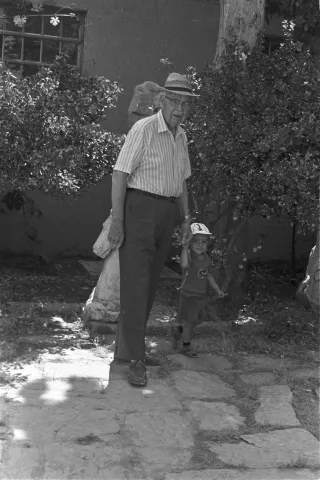
Oscar Broneer (left) with his 'grandson' Γιώργος Μπελίτσης (Giorgos Belitsis) in the Museum courtyard, 1981
Τίτλος Εικόνας

Oscar Broneer (left) with his 'grandson' Γιώργος Μπελίτσης (Giorgos Belitsis) in the Museum courtyard, 1981

Εικόνα
Εικόνα
Area of excavation by Broneer with circular base in the middle, ancient walls to the south and modern houses and road on top of antiquities, 1933
Τίτλος Εικόνας

Area of excavation by Broneer with circular base in the middle, ancient walls to the south and modern houses and road on top of antiquities, 1933

Εικόνα
Εικόνα
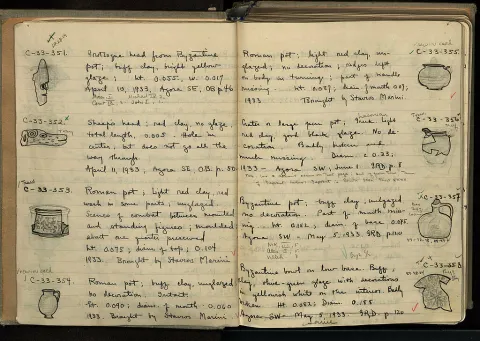
List of artifacts found and catalogued from Oscar Broneer's (OB) excavations along with other objects brought in by Stavros Marinis, in Find Inventory Book, 1933
Τίτλος Εικόνας

List of artifacts found and catalogued from Oscar Broneer's (OB) excavations along with other objects brought in by Stavros Marinis, in Find Inventory Book, 1933

Εικόνα
Εικόνα
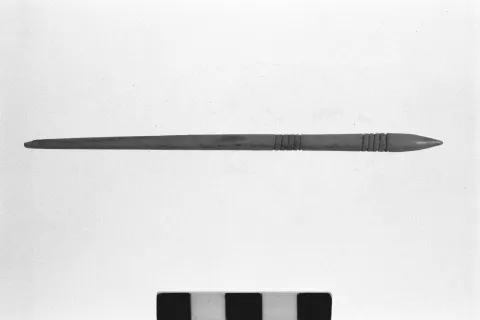
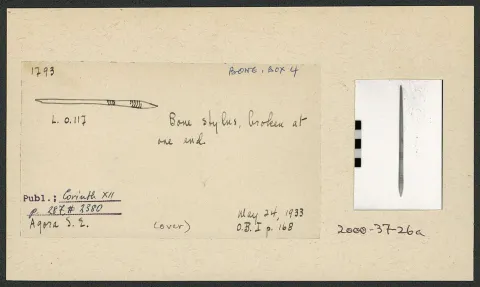
Byzantine bone pin of the 10th-12th centuries AD, half polished on the lathe (cat. no. MF 1793)
Τίτλος Εικόνας

Byzantine bone pin of the 10th-12th centuries AD, half polished on the lathe (cat. no. MF 1793)

Εικόνα
Εικόνα
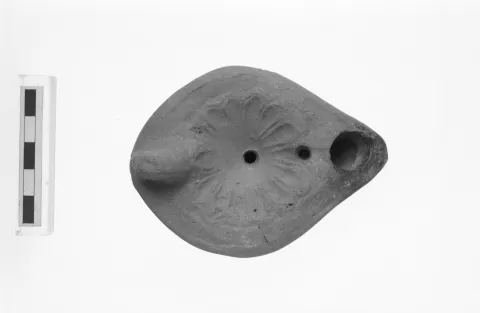
Roman terracotta lamp Broneer Type XXVIII with rosette decoration on disc, burning on nozzle, 5th-6th centuries AD (cat. no. L 1641)
Τίτλος Εικόνας

Roman terracotta lamp Broneer Type XXVIII with rosette decoration on disc, burning on nozzle, 5th-6th centuries AD (cat. no. L 1641)

Εικόνα
Εικόνα
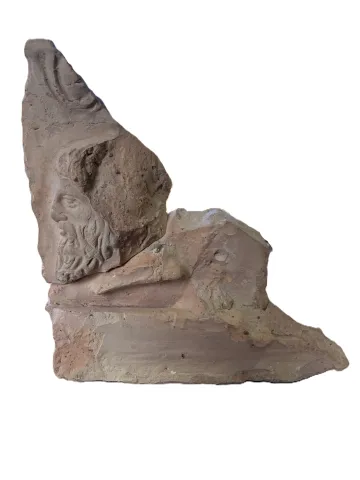
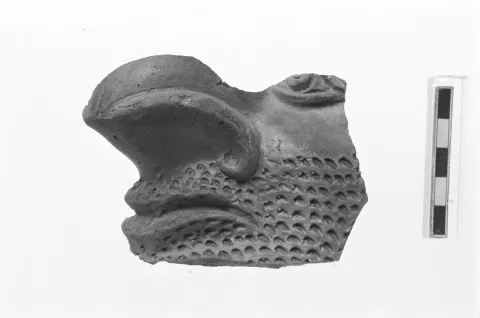
Roman terracotta sima with bearded head of Zeus (cat. no. FS 498)
Τίτλος Εικόνας

Roman terracotta sima with bearded head of Zeus (cat. no. FS 498)

Εικόνα
Εικόνα
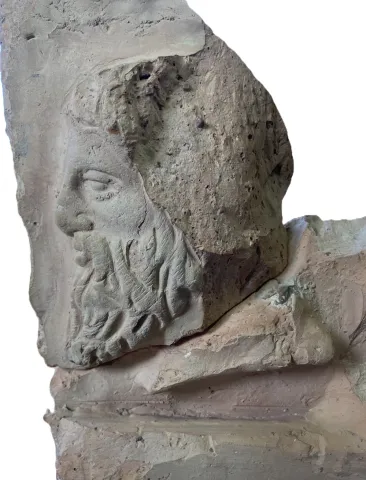
Roman terracotta sima with bearded head of Zeus, detail of head (cat. no. FS 498)
Τίτλος Εικόνας

Roman terracotta sima with bearded head of Zeus, detail of head (cat. no. FS 498)

Εικόνα
Εικόνα
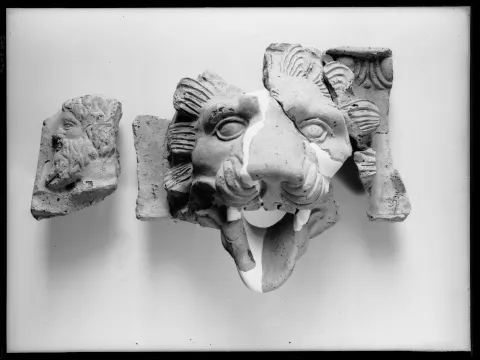
Roman terracotta sima with bearded head of Zeus and lion's head spout (cat. no. FS 498)
Τίτλος Εικόνας

Roman terracotta sima with bearded head of Zeus and lion's head spout (cat. no. FS 498)

Εικόνα
Εικόνα
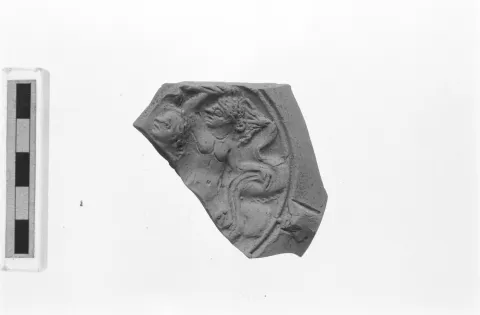
Roman terracotta lamp Broneer Type XXVII disc with Scylla and Charybdis representation, 2nd century AD (cat. no. L 1643)
Τίτλος Εικόνας

Roman terracotta lamp Broneer Type XXVII disc with Scylla and Charybdis representation, 2nd century AD (cat. no. L 1643)

Εικόνα
Εικόνα
Roman terracotta plastic vessel, lagynos?, in the form of a grotesque head, 1st-2nd centuries AD (cat. no. C 1933 1479 )
Τίτλος Εικόνας

Roman terracotta plastic vessel, lagynos?, in the form of a grotesque head, 1st-2nd centuries AD (cat. no. C 1933 1479 )

Εικόνα
Εικόνα
card
Τίτλος Εικόνας

card

Τίτλος περιεχομένου

Oscar Broneer Excavating in Vlachos’ Field

Main Media
Εικόνα
bw 2259_ Circular Monument
Αρχική φωτογραφία
Εικόνα
vlachos

Renting the Fields: The Disagreement between Hill, Blegen and the Bakoulis Brothers

Relationships were not always easy, since the archaeologists wanted to dig up the fields to expose the antiquities but the people needed to cultivate them and live from their produce.  Agreements had to be made and disagreements had to be resolved.  


The archaeologists working with a huge workforce, up to 100 and more workmen, were moving a lot of earth using carts and donkeys in order to reveal the ancient monuments. This earth had to be dumped away from the excavations.

Bakoulis was a big family as is indicated on the maps of properties where the family name appears repeatedly. The field owned by the Bakoulis brothers, Serafeim, Thomas, and Ioannis, sons of Demetrios, was rented out to the archaeologists for this purpose, to dispose of the earth temporarily while the monuments were uncovered.

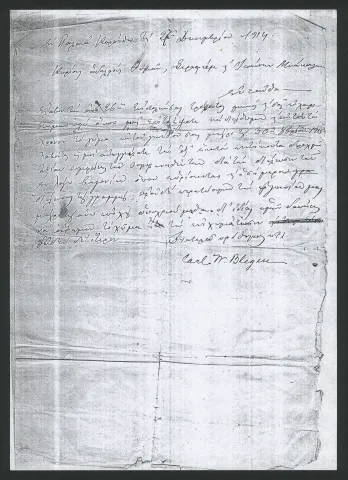
Correspondence between American archaeologists, Bert Hodge Hill (Director of the American School 1906-1926) and Carl W. Blegen (Secretary of the ASCSA 1913-1920), and the Bakoulis brothers describes the agreements made for the Americans to rent the field for dumping the earth, then to return it to its owners for cultivation for the remainder of the year. However, agreement on the terms and conditions of the collaboration did not come easily.

Blegen wrote, “I saw the Bakoulides today twice and had a long discussion with them. They refuse absolutely to let us cross their land except for 2 100 dr notes. 2 of them Seraphim and Thomas talked very brutally and called us liars. They assert their agreement with us was for 3 months, not for the year. The signed paper, however, which I showed them says ‘during 1914 to end of work of 1914’! They say if we attempt to run a car they will have the law on us. Finally said "the matter is finished.” We urged them to reconsider. Prospects not good.” (ASCSA Corinth Excavations Notebook 78, p. 8, October 8, 1914) 

Further down, Blegen continued: “Angelis (Kosmopoulos, the foreman) says he will go ahead tomorrow in spite of Bakoulis. He has looked up law and finds it is on our side. We are required to pay damage to crop, mainly and have full rights of passage. Question of next year is different. There seems no further use in negotiating with Bakouli. It is quite impossible to deal with them. We have tried every way we could think of.” (ASCSA Corinth Excavations Notebook 78, p. 15, October 11, 1914) 

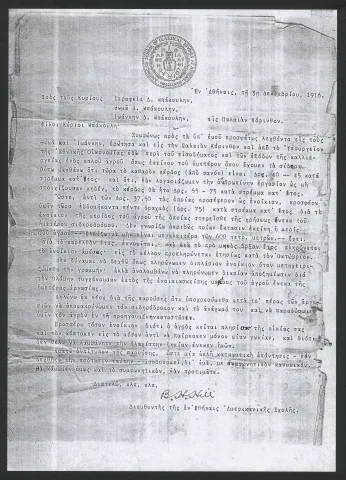
The Bakoulis brothers caused problems for the archaeologists, even though they were paid a fair sum to rent out their fields for the disposal of excavation soil. Recently, Ioannis Bakoulis, one of the grandsons of the three brothers, who still lives in the village, handed over to the ASCSA a letter sent to the Bakoulis brothers by Bert Hodge Hill in 1916.

Hill stated in the letter that he had investigated in Ancient Corinth and with the Ministry of National Finance regarding the profit from the cultivation of wheat in the field as amounting to 65-75 drachmas per stremma. He thus, offered the brothers to rent their field for 75 drachmas per stremma. He concluded, “I offer this rent…because I do not want you to suffer any damage because of us.”


On
Υπότιτλος Εικόνας

Excavation dump in Bakoulis Field, 1905

Εικόνες
Εικόνα
Εικόνα
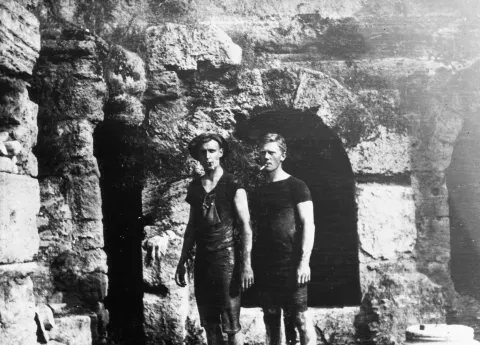
Carl W. Blegen (on the right) with Emerson Swift, both covered in mud after excavating in the tunnels of Peirene (1913-1914)
Τίτλος Εικόνας

Carl W. Blegen (on the right) with Emerson Swift, both covered in mud after excavating in the tunnels of Peirene (1913-1914)

Εικόνα
Εικόνα
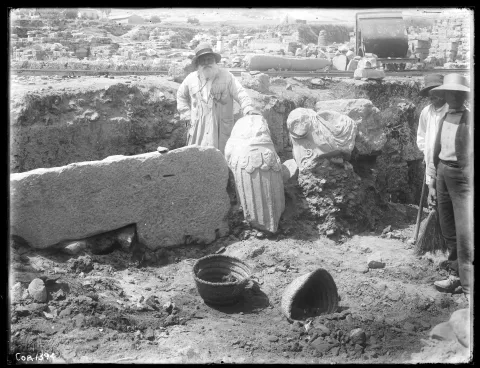
The foreman, Angelis Kosmopoulos, in the Baths of Eurykles, in 1919
Τίτλος Εικόνας

The foreman, Angelis Kosmopoulos, in the Baths of Eurykles, in 1919

Εικόνα
Εικόνα
Bert Hodge Hill's letter to the Bakoulis brothers, Serafeim, Thomas, Ioannis, dated December 3, 1916
Τίτλος Εικόνας

Bert Hodge Hill's letter to the Bakoulis brothers, Serafeim, Thomas, Ioannis, dated December 3, 1916

Εικόνα
Εικόνα
Carl W. Blegen's letter to the Bakoulis brothers, Serafeim, Thomas, Ioannis, dated December 27, 1914
Τίτλος Εικόνας

Carl W. Blegen's letter to the Bakoulis brothers, Serafeim, Thomas, Ioannis, dated December 27, 1914

Τίτλος περιεχομένου

Renting the Fields: The Disagreement between Hill, Blegen and the Bakoulis Brothers

Main Media
Εικόνα
1704_sh
Αρχική φωτογραφία
Εικόνα
bakoulis

Entry Corinth

The geographical location of Ancient Corinth made it one of the most important cities of ancient Greece. The city held great strategic significance throughout its existence as an ancient Greek city, as well as later for the Roman Empire, Byzantium, the Franks, the Venetians, and the Ottomans—right up to the present day.

It is only natural that a region with such a rich history would attract the interest of travelers and archaeologists alike. The first archaeologists from the American School of Classical Studies began excavations at Ancient Corinth in 1896. 

The excavations carried out by Greek and American archaeologists have brought to light an enormous number of findings. One of the main goals of the American School—beyond studying, publishing, and exhibiting the archaeological discoveries in the museum to make them accessible to the general public—is the preservation, conservation, and maintenance of the records produced from the very first dig in 1896 to the excavations of the present day, 129 years later. 

Generations of archaeologists working in the area have created an extensive archive of their excavations in various forms, which serves as the foundation for publications on legacy data as well as future archaeological research. This archive also contains the stories of local families and individuals who worked alongside archaeologists to uncover the ancient city and its people’s way of life. 


Off
1st in greece ai platform for greek colture

A comprehensive system for managing cultural materials
and collections using artificial intelligence